
Of Brain and Inking Comics
Some fun trivia on brain science and comic art process

Do you listen to things when you work on your comics or graphic novels?
Like most creatives, my answer is, “It depends.”
When I am just doodling for fun, I can listen to anything. When I am drafting a story, it requires complete silence – I need full concentration as I problem-solve my way out of a story structure. I can’t listen to anything either when I am paneling or sketching roughs. That also requires my utmost focus. (Mihaly Csikszentmihalyi calls this the state of “flow”.)
One interesting thing I recently discovered is the process of inking. Over the past weeks, I have been frantically catching up with inking work for a project. On the surface, inking seems like a relatively straight-forward step. After all, I have already done the problem-solving part in the sketching phase. To me, inking is more of a time-and-labor intensive phase that is mostly muscle-memory. So, I decided to listen to an audiobook simultaneously. As chance would have it, my audio copy of Nassim Nicholas Taleb’s The Black Swan was ready to be checked out on Libby.
Perfect!
Or not! After listening to about 55% of the book as I worked, I stopped. It’s a really interesting book, and I can’t wait to get my hands on the physical copy, but the audiobook did NOTHING for me. By nothing, I mean I didn’t retain a single word.
It was noise going in and out of my brain.
I even felt annoyed, as if someone was bothering me when I was trying hard to concentrate with my work.
But when I tried inking in complete silence, I felt extremely bored.
In the end, I opted for listening to a Cantonese YouTube channel that discussed about old murder court cases in Hong Kong. It had absolutely nothing to do with my work, and it felt perfect.
I couldn’t help but look at this situation through the lens of a book I enjoyed: Seven 1/2 Lessons About the Brain, by Lisa Feldman Barrett.
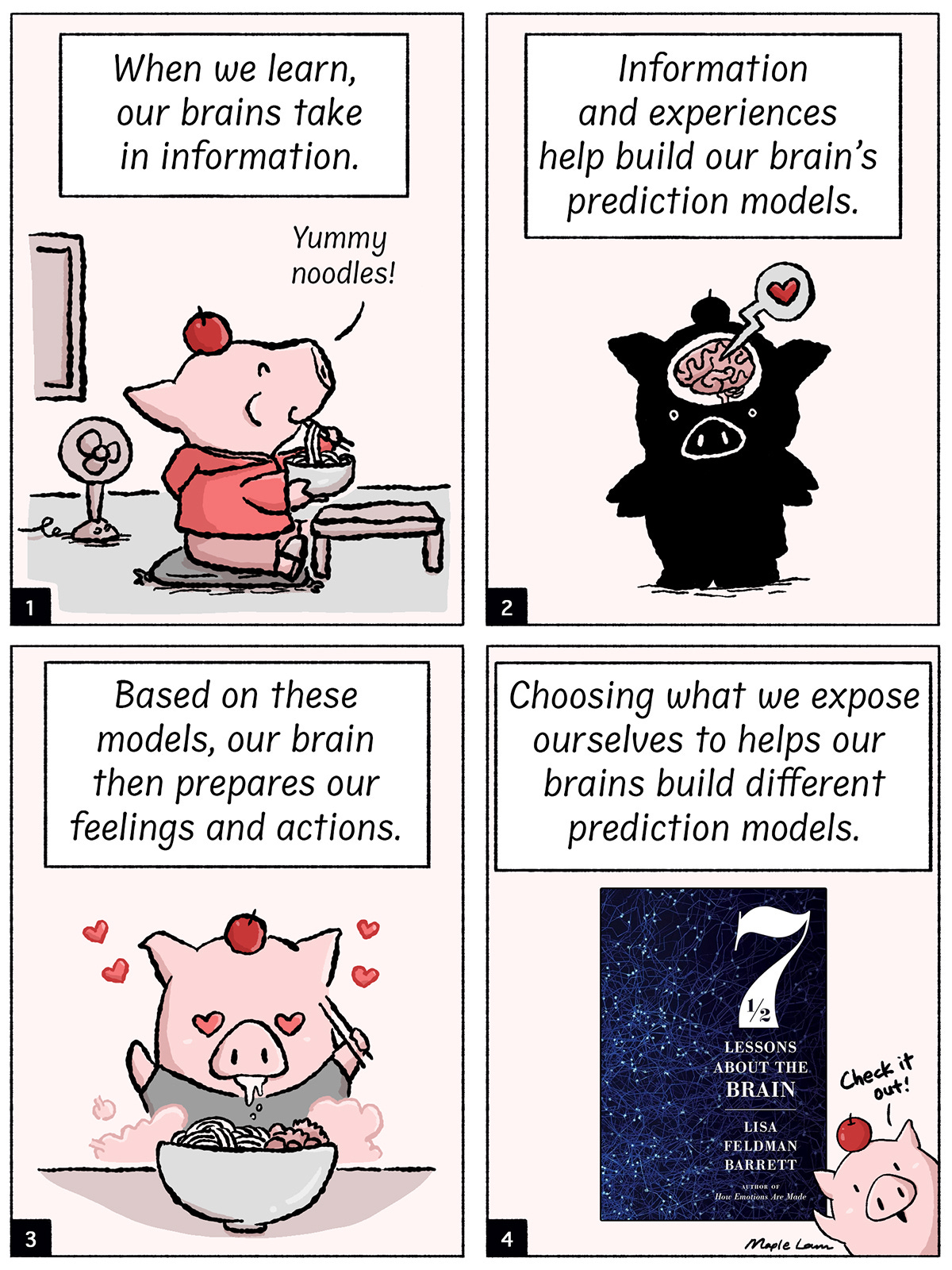
One of the most interesting things I learned from the book is that our brain loves predictable input:
“Brains aren’t wired for accuracy. They are wired to keep us alive… It’s metabolically costly for a brain to deal with things that are hard to predict.”
Taleb’s The Black Swan explores epistemology, probabilities, and philosophy. It is an interesting book with new cognitive models (to me) that requires me to pause, to think, to argue and counter-argue. In short, it is asking my brain to work.
And our brain likes to protect us as all cost. It is always regulating for body efficiency and making sure I stay alive. (This kind of body-budgeting is called allostasis, a concept that Barrett explained in details brilliantly in the book.)
“Complex bodies needed something more than a handful of cells to ensure that water and blood and salt and oxygen and glucose and cortisol and sex hormones and dozens of other resources were all regulated well to keep a body running efficiently.”
New concepts equate to something hard for my brain to predict.
If I were simply reading the book with nothing else going on, I could override that brain protection. But I was inking. A part of my brain was already working on prediction output. Granted, it’s a low-cost one, considering I mostly knew what I was doing. Still, there were times when I had to fine-tune perspectives, or vary pen nip thickness for contrasts, etc. Those switches cost energy, and they were energy I immediately zapped from listening to the audiobook, which demanded high-cost cognitive function.
So, my protective brain decided to phase out what I was listening to.
On the other hand, listening to a Cantonese YouTube channel that discussed old murder court cases hit a sweet spot in my brain, metabolically. Cognitively, it’s quite lightweight. It generated just a tiny bit of adrenaline to entertain me*, but the story distance in time and location gave me a sense of being safe. (All those murder cases happened long ago half a world away, for me.) My brain must have calculated this as cheap predictions, so it allowed for me to combine these two activities in this scenario.
* I really should clarify that this is not me somehow endorsing murder. No, no, no. Murder is bad. MURDER BAD! This channel discussed the murder cases from legal perspectives, which is fun in a Sherlock-Holmes way.
Of course, all this is me, a non-neuroscientist, expressing my non-professional opinion based off my interpretation of the book.
Brain-science is one of those super interesting fields that is fun to follow. The brain is so mysteriously complicating, and it’s fascinating!
Don’t you think?

Check out Barrett’s Seven and a Half Lessons About the Brain to learn more!
—
If you are interested in brain science and want to learn more about it through comics, I also recommend Science Comics: The Brain – The Ultimate Thinking Machine, written by Tory Woollcott and illustrated by Alex Graudins. It’s a fun one!



What do you do when you draw? Do you listen to audiobooks, podcasts, radio, music, YouTube channels? Any good ones you would recommend? Or perhaps you have to work in complete silence? Share how you work in the comments below! ٩(●˙▿˙●)۶…⋆ฺ
Interesting, Maple… the brain science behind flow.
Writing definitely requires my whole brain— no room for extra stimulation. It’s a relief when I get to the stage when I can listen to something. And it has to just right… no irritating reader, it has to be interesting but not TOO interesting, etc etc.
(Also… murder BAD 😂 very bad)
So this proves again what the professionals always told us: "Inking is thinking." It's thinking about the light source, about line widths, about texture, shadows, depth of field... up until the deadline hits. Then it's, "Don't think, just ink!!"